January 16, 2010
April 13, 2009
Obama and the pirates
I don't have time to say much about this other than that I'm disappointed (though not surprised) that so many on the right can't bring themselves to celebrate this because their guy didn't get elected in November. And yes, much of the Left did the same thing for the past eight years, but that doesn't make it okay. So even if I never have occasion to do it again, I'm drinking a toast to Obama and dead pirates.
April 08, 2009
Vermont and gay marriage
Vermont is now the fourth state to legalize gay marriage, but the first to do so legislatively and not through the courts. As soon as I heard the news, I wondered how those conservatives would react who have railed against "activist courts" all this time rather than attack gay marriage directly. These folks claimed to be much more upset at judicial usurpation of legislative authority and the thwarting of the popular will than anything else.
Well Vermont called their bluff, and here's the reaction. That's pretty weak beer, and awfully damn unconvincing if you ask me. I suppose if I were forced at gunpoint to pen an editorial attacking Vermont's gay marriage bill, I probably couldn't have done any better than the editors of NR. But then again, if that's the best argument I could come up with I'd be forced to reconsider my position. This is not a principled argument, in my opinion, but rather a half-assed attempt to retrofit some philosophical framework around a preexisting prejudice. Not mainstream conservatism's finest hour.
But then as my friend Pete points out, it's also amusing to watch the liberals' new-found ardor for states' rights.
Ah well. In the meantime let's drink a toast to Vermont. Remember that you can already pack a concealed pistol there even without a permit! You've gotta admire such a freedom-loving state. It's kinda like that old Glen Reynolds thing about wanting to live in a place where you could attend your friends' gay marriage and give them assault rifles as their wedding gift. Yeah, the tax burden is oppressive, but you can't have everything. Taxes are high here too and I get none of the perks (guns, gay marriage, beautiful lakes, great ice cream, rustic farm houses and skiing.) Maybe it's time to move.
April 06, 2009
Man shoots himself during "Watchmen" movie
I can relate. I had a similar reaction during "Portrait of a Lady."
April 04, 2009
Manhattan responds to the recession
Taken on 9th Avenue in Hell's Kitchen this morning.

March 20, 2009
Heh
I'm glad that Bush didn't do this because that would have been stupid.
March 11, 2009
I'm ahead of my time, once again
It will probably surprise no one that I read a bunch of Ayn Rand when I was in college, but I never tackled her magnum opus, the 1200-page behemoth Atlas Shrugged. But for some reason, I felt compelled to change that a few months ago. I can't tell you why. I even survived the hype surrounding the 50th anniversary a couple years back without succumbing, but a couple of weeks ago, for some reason, I felt that I had to read Atlas Shrugged.
I expected it to be a chore, but I was amazed at how swiftly and how utterly it pulled me in. I began telling a like-minded colleague about the book and told him he should read it too. But when the local bookstore proved to be sold out of it, I went online to try to find him a copy in the local library system. This next will sound hard to believe, but it is true. Out of 79 libraries in four nearby counties, every copy was currently checked out. Every. Single. One.
The I saw this story about how sales of Atlas Shrugged are skyrocketing. I'm such a trendsetter! And check out this recent photo from the NY Daily News.
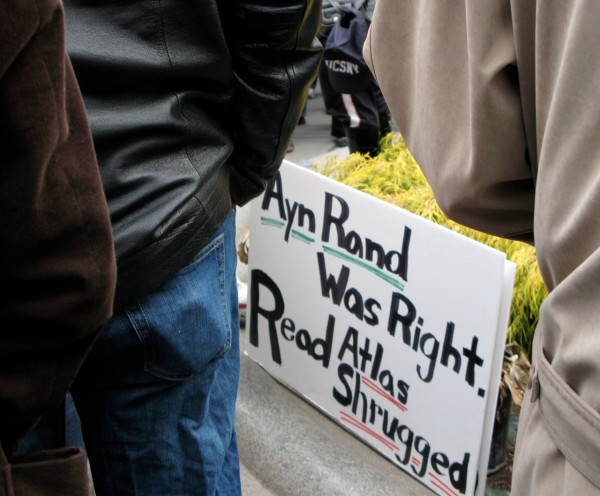
So what happened? It's not just me, I guess. It's almost like a whole army of us folks were suddenly "activated" like Cylon plants or something, and spontaneously felt compelled to read some 52-year-old melodramatic novel. Weird, huh?
So anyway, let's talk about the book (even though I'm only about halfway through, because I'm an embarrassingly slow reader and I always read at least three books simultaneously.) Doubtless one of the reasons I'd never taken the plunge before now was the scathing critiques I'd read of her fiction even 20 years ago (most of her work that I read in college was essays and the like.)
To be fair, I found that many of the knocks against Rand's fiction are somewhat deserved. She's about as subtle as a daisy cutter for one thing, and she can sometimes beat you over the head when making a political statement. And yes, her prose is at times overwrought and turgid. But you know what? She's still better than 90% of the dreck on the NYT bestseller list. Hell, compared to Dan Brown, she might as well be Shakespeare.
And yes, the delivery mechanism for much of her political philosophy here is a trashy soap opera with breathless dialog. But remember, Rand was writing in her second language! And soap opera though it may be, it is as compelling as any fiction I've read in years. I just got done with this ludicrously melodramatic scene involving two women arguing over a bracelet at a wedding party and I could not put it down!
There's something to be said for that, Rand's literary detractors notwithstanding. I used to steadfastly defend the prose of Ian Fleming for the simple reason that he could write 30 or 40 pages about a baccarat game or a round of golf and keep me totally absorbed the entire time. That's genuine talent as far as I'm concerned, and Rand has it in spades. In fact, Rand would no doubt value Fleming's writings herself, if not because of their content then because of their commercial success. I could prove my point, but it would give away too much of the novel for those who haven't read it (but pay particular attention to the character of Balph Eubank.)
And now I'd like to address some of the other criticisms I've heard of the book over the years. First, that its protagonists (Hank Rearden, Dagny Taggart, et al) are assholes. Well of course they're assholes. They're heartless, inhuman automatons. But they had to be. It was necessary to prove her point. If they'd been some nicey-nice capitalists with hearts of gold or with a "social conscious," it would have completely undercut the thesis of her book. Rand wanted to illustrate that people who acted solely in their own self-interest were ultimately more beneficial to society than a raft of do-gooders, who ultimately have to rely on the wealth of the actual producers to further their sanctimonious, self-righteous ends.
And anyone who thinks Rand glorifies corporatism simply hasn't read the book. Most of the corporate types in the novel are loathsome wretches, and the real enemy in Atlas isn't so much "government" as that unholy alliance between government and corporate lowlifes who seek favorable legislation to help line their own pockets.
To modern readers, it might seem unrealistic the way Rand depicts the American landscape as fraught with avid collectivists and redistributionists at every turn. But remember, this was a different era. In 1957, when the book was published, the top marginal income tax rate was 91% (I shit you not!) and blatant appeals for socialism were much more common in genteel society than they were in the post-Reagan country most of us now consider normal.
In the end, my biggest critique of Any Rand is that she ultimately went from brilliant antistatist to cult leader. Her antipathy for religion (both conventional as well as the secular religion of collectivism) is sadly ironic in that she became a de facto religious leader herself. Granted, she cannot be held responsible for the excesses of all the Objectivists who followed her, but she was given to demanding absolute fealty with statements such as, "If you agree with some tenets of Objectivism, but disagree with others, do not call yourself an Objectivist." In short, she eventually acquired all the aspects of a religious leader -- including, if I read between the lines correctly, an aversion to alcohol(!)
But all of that being said, it's a terrific read, and I wish I'd read it earlier. If you've read this far and still haven't read Atlas Shrugged, then that means you need to right away. Go grab a copy (if you can find one!) and read it. We'll discuss it later.
March 09, 2009
McCain in 2012!
Meghan, that is.
March 08, 2009
Mesage to Rush
So I got a Kindle

I just got a Kindle, and it's very interesting. I've had it for about two weeks now, and I must say I like it much better than I expected. I never really enjoyed reading text on a glowing, flickering screen (you'd never know it, right?) but this passive, eInk technology is pretty cool! It looks for all the world like someone ripped a page out of a printed book and pasted on the surface of the Kindle.
My only fear (which I'm sure is all part of Amazon's nefarious plan) is that having immediate access to all these books will prove too seductive, and all my money will go shooting over to Jeff Bezos of WhisperNet.
March 07, 2009
Dogs in heaven
I saw this on PostSecret recently. It's a nice thought, isn't it? When we take our own puppy to our local doggie playground, we always like how all the dogs immediately stop what they're doing and run over to the gate with tails wagging every time a newcomer arrives. So who knows? Perhaps it's true.
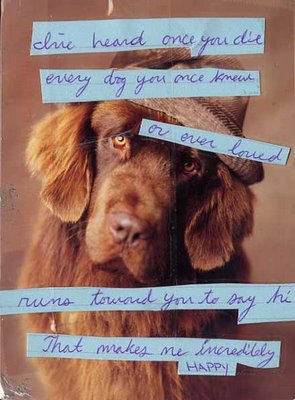
On a related note, remember that old Twilight Zone episode? Don't be tricked.
March 06, 2009
I'm a bourbon guy
And I don't really care for Canadian Whiskey. But this ad makes me wish I did.
March 05, 2009
What's wrong with this picture?
A New York City doctor has come up with an inventive plan to treat uninsured patients for a nominal monthly fee. So what does the state do? Try to shut him down, of course!
March 03, 2009
Well this sucks
This bill is one of the worst ideas I've seen come before Congress in a while, and that's saying something. The idea is to make "Wall Street" pay for the TARP bailout by imposing a 0.5% tax on stock transactions.
These days it's hard enough to find winning stocks period, even without having to take a whole percentage point off a round-trip stock purchase. Do you ever rebalance your 401k? Well then that makes you "Wall Street" in their eyes, and you're going to get hit with penalties. And even if you don't move your funds around, chances are your fund manager is doing it for you, which means you'll get hit this stupid tax even if you do nothing at all. And if (like me) you're a trader, then forget it. Especially a day trader. You're out of business.
Now I know that traders aren't viewed with a lot of sympathy out there. It's almost as if they're doing something sleazy or vaguely immoral, unlike the sainted "investors" who aren't constantly buying and selling every second of the day. But here's the problem. Whether you're a trader or investor, you benefit from a liquid market. For most listed stocks, you can always buy or sell at pretty damn near the officially quoted price. Why is that? Because there's a sufficient volume of traders out there who are always looking to buy or sell a given issue at a given time. Markets aren't liquid because the Warren Buffetts of the world come along every decade or so and buy a million shares of Coca-Cola and sit on it for eighty thousand years. Markets are liquid because of the dirty little traders out there, always looking to make a quick turnaround. Despise them if you want, but if you run them out of business, then your market doesn't work anymore, even if you're an "investor."
I really, really wish Congress would spend two seconds thinking about this kind of stuff because engaging in such stupidity.
Why David Brooks suxes
I realize I shouldn't even bother with this post, because what else does one expect from a "conservative" that the New York Times would give steady work on its Op-Ed page... but what can I say, I'm bored. Anyway, this is a perfect example of why I find Brooks too lame and annoying for words.
It has nothing to do with defending Bobby Jindal, who performed horribly in the GOP response to Obama's quasi-SOTU address, and whose baggage as a religious nut and amateur exorcist will make him dead meat if the Republicans are stupid enough to run him on the national level.
But Brooks' stupidity goes well beyond that kind of valid criticism. To him, Jindal is a "nihilist" because he dares criticize "waste" and "earmarks" in Obama's stimulus legislation. Unbelievable. And it's not like Brooks doesn't have his own problems with his erstwhile (three weeks ago) hero Barack Obama. Sorry, but I find that column to be nonsense as well. I don't see Obama doing any kind of "immoderate," left-wing stuff that he didn't tell us in plain English during the campaign that was going to do. Whence the buyer's remorse?
No wonder the Times loves Brooks. He's their favorite kind of "conservative" -- self-loathing, philosophically vacuous, dedicated to big government, and suffering from the same kind of all-round generic wussiness that afflicts the rest of the Times' editorial department.
All right, enough about Brooks. I regret spending this much time on him already.
Lol
Tim Geithner's going after tax cheats. (Yeah, I know avoiding taxes in only important if you're a plumber from Ohio and doesn't matter a damn if you're Treasury Secretary, but you've gotta admit it's still kinda funny.)
March 02, 2009
Some numbers and a question
During the eight years of Bush's presidency, the Dow Jones Industrial Average lost 2,638 points. In the two years since the the Democrats took control of congress, the Dow has lost 5,717 points. In the month and a half since Obama was sworn in, the Dow has lost 1,186 points.
For now, Obama can still lay all the blame for the state of the economy at the feet of his predecessor. But for how long? At which point, both in time and in DJIA points, will the Democrats officially own current economic conditions? (Note that this is a political question, not an economic one.)
March 01, 2009
A personal note
I have a baby niece being born in Boston right now. The mom keeps texting us updates from her hospital bed. I love the 21st century. :-)
(It occurred to me that the title of this post owes a debt to Paul Harvey (*sniff*) See previous post.)
February 28, 2009
Ouch
I'm taking Paul Harvey's death harder than others might, because to me he was not just some guy on the radio, but rather a part of my childhood. I remember hearing Harvey's voice over the airwaves from the time I was old enough to know anything. Back during the early 70's, before I even started school, my father would often drive home during his lunch hour to have lunch at home. I remember he would always, always tune the radio to Paul Harvey. Whenever I'd hear that amazingly distinctive voice on the air, I'd get excited because I knew my Dad was coming home.
In this way, Paul and my Dad were always intricately linked in my head as I grew up. When I went away to college, I'd always smile when I heard his broadcasts. By this time, Harvey was altogether a product of a different era. (Hell, that was probably even true in 1970 when I first heard him.) I wouldn't listen to him in front of my friends, because Harvey's frequent forays into the mawkishly sentimental would often prove embarrassing, but whenever I was alone, the sound of his voice comforted me and made me feel a bit closer to home.
When my own father passed away in July of 1999, Paul Harvey kept on going. He was like Old Faithful, or some other predictable, unstoppable force of nature. He was one of the very few true constants over the course of my life, still doing exactly the same schtick at noon every day as he did 35 years ago. It was truly amazing. And rather than finding it painful to listen to Paul Harvey after losing my Dad, I found it once again very familiar and comforting. It was good to know that some things never changed.
Ironically, it was just this past week that I had to run an errand on my lunch hour, and when I cranked the car I heard that familiar voice once again. Maybe there were a few more cracks in it than there were during my preschool days, but everything else -- the voice, the cadence, the idiosyncrasies -- were all exactly as I had remembered. I marveled at this, and his advanced age, and actually found myself wondering for how much longer this voice would continue to be a part of my life. Well, now I know.
Mr. Harvey, I'll miss you. Every time I'm ever in a car or near a radio at midday. And wherever you are, I know you're still going to be as busy as you ever were. But I do hope you'll find a spare moment to look up my Dad. He was a loyal listener and fan for many, many years. He'd be thrilled to shake your hand... and I think the two of you would like each other.
February 25, 2009
Byrd vs. the czars
Robert Byrd, the new Strom Thurmond (racist background, unspeakably ancient, and third(!) in line for the presidency) is taking President Obama to task for what he sees as an executive power grab -- namely the proliferation of "czars" to oversee White House policy.
I don't like czars much either, but the good thing about them is that they have very little actual power. Which is a good thing, since otherwise Byrd's accountability and checks and balances concerns would be valid. But then again, that doesn't make them very good "czars," does it? Czars, if I recall correctly, were autocratic tyrants, not toothless bureaucrats.
In this sense the new czars are preferable to the old, but who's bright idea was it to create a government position and call it a "czar" in the first place? In a better world, such a move would have been as unpopular as the creation of a "Health Care Despot," or a "Climate Change Inquisitor." Instead, it's become a trend. And why? Have any of them ever been successful at anything? Wasn't the first such position a "drug czar?" How well did that work out?
Obama's not the first president to appoint a "czar," but they do seem to be multiplying under this administration. Maybe I don't see the "czar" concept as quite the threat to democracy that Byrd does, but at the very least they are awfully silly, and I wish we could rethink the whole thing.
Contact
My Favorite Bloggers
- 123beta
- Ace of Spades HQ
- aldaynet
- Beluthahatchie
- Blue and White
- Brilliant at Breakfast
- Classical Values
- Concealed Position
- Creative Destruction
- Dave Budge
- Dave's Not Here
- Dean Esmay
- Donkey Cons
- Drink this...
- dummyspots
- Ex-Donkey Blog
- Freeman Hunt
- GOP and the City
- I'm Sick of Mike
- Iraq War was Wrong
- Kurticus Maximus
- little green footballs
- Mr. Snitch
- MUSC Tiger
- My Pet Jawa
- Le Mont de Sisyphe
- Palmetto Pundit
- Radio Blogger
- Risawn
- The Royal Flush
- Samantha Burns
- Scaramouche
- Schismatic Pandemonium
- Selling out America
- Semi-sweet, somewhat bitter
- skippy the bush kangaroo
- Soobee
- Sophistpundit
- Sweet Spirits of Ammonia
- Tami
- This Goes Without Saying
- Unpopulist
- Urthshu
- V the K
- Without Feathers
- Workingclass Conservative
Other Jerks Who Don't Link To Me
- The Agitator
- Alphecca
- Althouse
- Belmont Club
- The Black Republican
- Captain's Quarters
- Cato Unbound
- Confederate Yankee
- The Corner
- Counterterrorism Blog
- Dorkafork
- Drumwaster
- DUI blog
- Dynamist
- Eggagog
- Feisty Republican Whore
- Free Will
- FUCK YEAH CILANTRO!
- Garfield Ridge
- Gay Patriot
- Healing Iraq
- Hit & Run
- Hog on Ice
- IMAO
- INDC Journal
- Insults Unpunished
- InstaPundit
- iowahawk
- Iraq the Model
- Treacher
- Just One Minute
- Kausfiles
- Laurel Zimmer
- Megan McArdle
- Michael Graham
- Neolibertarian Network
- neo-neocon
- Patterico
- The Plank
- Power Line
- Protein Wisdom
- RealClearPolitics
- Samizdata
- Sandmonkey
- Roger L. Simon
- ScrappleFace
- Seeking Alpha
- Seriously Good
- Slow Cooker Recipes
- Snooze Button Dreams
- So Sue Me
- Spoiled Brats
- Tammy Bruce
- This is Why You're Fat
- Tim Blair
- Trader Mike
- The Truth Laid Bear
- VodkaPundit
- The Volokh Conspiracy
- Winds of Change
- WuzzaDem
Lefty Bloggers
Indispensable Stuff
Moonbats, Wingnuts and Conspiracists
Search
Archives
- January 2010
- April 2009
- March 2009
- February 2009
- January 2009
- December 2008
- November 2008
- October 2008
- September 2008
- August 2008
- July 2008
- June 2008
- May 2008
- April 2008
- March 2008
- February 2008
- January 2008
- December 2007
- November 2007
- October 2007
- September 2007
- August 2007
- July 2007
- June 2007
- May 2007
- April 2007
- March 2007
- February 2007
- January 2007
- December 2006
- November 2006
- October 2006
- September 2006
- August 2006
- July 2006
- June 2006
- May 2006
- April 2006
- March 2006
- February 2006
- January 2006
- December 2005
- November 2005
- October 2005
- September 2005
- August 2005
- July 2005
- June 2005
- May 2005
- April 2005
- March 2005
- February 2005
- January 2005
- December 2004
- November 2004
- October 2004
- September 2004
- August 2004
- July 2004
- June 2004
- May 2004
- April 2004
- March 2004
Recent Posts

Glenn Reynolds Says
-
"If Barry were the last blogger on Earth, I'd read him."
Proud Member of the Alliance




Powered by
Movable Type 3.2
Movable Type 3.2